Every week there’s a new thread: “I asked ChatGPT to analyze this stock and it gave me a full investment thesis.” It sounds like magic. The problem is that if you don’t know where the AI is actually looking — and where it’s making things up — that thesis can be built on numbers that don’t exist.
This guide is direct and honest. We’re not going to tell you AI is useless for investing (it isn’t), or that it replaces your judgment (it doesn’t). We’re going to draw a precise line between what a model like ChatGPT, Gemini or Claude does well in fundamental analysis, where it fails dangerously, and how to set up a workflow where AI helps you without slipping a fake number into the middle of your analysis.
The one-sentence rule
If you take only one idea from this article, make it this:
Language models are good at reasoning over data you give them, and bad at recalling data on their own.
Almost every serious AI mistake in stock analysis comes from asking it to recall numbers (prices, ratios, a specific quarter’s revenue) instead of giving it the numbers and asking it to reason. We expand on this below.
What AI does well in fundamental analysis
For these tasks, a current model adds real value and saves you time:
- Summarizing long documents. Paste a 10-K, an annual report or an earnings call transcript and the AI extracts the essentials, the stated risks and the changes in language versus last year. If you don’t know what a 10-K is, we have a guide to reading one.
- Explaining concepts at your level. “Explain ROIC like I’m 15” or “why does this business have high margins?” are questions it answers excellently. To go deeper, see our fundamental analysis guide and what ROIC is.
- Structuring a thesis. Give it your messy notes and it turns them into a thesis with pros, cons and what would have to be true for it to fail.
- Comparing qualitatively. “How does Visa’s business model differ from PayPal’s?” is something it nails, because it’s reasoning, not memory of figures.
- Generating checklists and questions. A great way to not skip steps: “give me 10 questions I should answer before investing in an airline.”
- Translating the jargon. It turns accounting and financial language into something readable.
In all these cases the pattern is the same: the AI works on text and concepts, and doesn’t depend on recalling an exact number.
Where it fails dangerously
This is where most people get into trouble without realizing it:
- It invents figures. Ask for “the last 5 years of revenue for this company” and it’ll give you a perfect-looking table… that may be fabricated. This is called a hallucination, and in financial data it’s been documented to happen at an alarming rate.
- It fabricates prices and ratios. Ask for a stock’s closing price yesterday and it’ll give you a number with two decimals that sounds right. Unless it has live access, it’s making it up.
- It invents sources, dates and analyst ratings. When you ask for references, it sometimes generates reports or analyst ratings that look real but don’t exist.
- It has a knowledge cutoff. A base model “doesn’t know” what happened after its training. Without connected tools, it can’t see the latest quarter or today’s market.
- It’s more descriptive than quantitative. It tends to describe (“the services segment grew”) instead of calculating the exact percentage, unless you give it the numbers and explicitly ask.
The professional consensus is unanimous: AI can assist with research, but it should never be the source of the data you make investment decisions on.
ChatGPT vs Gemini vs Claude for this task (honest take)
There’s no absolute winner; it depends on what for:
- Gemini tends to do better when you need recent data, thanks to its search integration and deep-research feature. It also handles very long documents well.
- ChatGPT excels at writing and extended reasoning, and produces very natural prose — useful if you’re turning analysis into notes or content.
- Claude is strong at reading long documents carefully and holding the context of a full report.
But note: all three will hallucinate figures if you ask for them from memory. The difference between them matters far less than the difference between “asking it for data” (bad) and “giving it data” (good).
The workflow that keeps AI from lying to you
Here’s the practical part. A repeatable process for using AI in fundamental analysis without it sneaking in fake data:
- You bring the data, not the AI. Copy the real financial statements (income statement, balance sheet, cash flow) from a reliable source and paste them into the prompt. Now the AI reasons over verified data, not its memory.
- Ask for calculations, not recollections. “With these figures, calculate the operating margin and ROIC year by year and tell me the trend.” This uses its reasoning and removes its ability to invent.
- Make it cite the line. “State which row of the data I gave you each number comes from.” If it can’t point to it, be suspicious.
- Always verify the key numbers against the primary source (the original report). For important decisions, this isn’t optional.
- Use AI for the questions, not the final answers. Let it help you think about what to look at; the decision and the valuation are yours.
Same goal, two prompts: one lies, the other doesn’t
To make it concrete — say you want to understand a company’s profitability:
Unsafe prompt (don’t use this): “What is Coca-Cola’s ROIC and how has it evolved over the last five years?”
It looks like a reasonable question, but it forces the model to recall figures. It will return a series with plausible decimals that may be outdated or outright invented — with no way to tell the real numbers from the fabricated ones.
Safe prompt (same goal): “Here is verified data for this company, copied from its annual report: revenue, EBIT, shareholders’ equity and debt from 2021 to 2025 [paste the table]. Calculate ROIC year by year stating which rows each number comes from, describe the trend, tell me what risks you see in the margin evolution, and give me three questions you would ask before investing.”
The goal is the same, but now the model calculates over data you gave it, can cite the source row for every figure, and its output is questions and analysis — not numbers from its memory.
In practice, the full loop takes minutes: open the company in your data tool, copy the multi-year fundamentals table, paste it with the safe prompt, and check any new figure the AI returns against the original table.
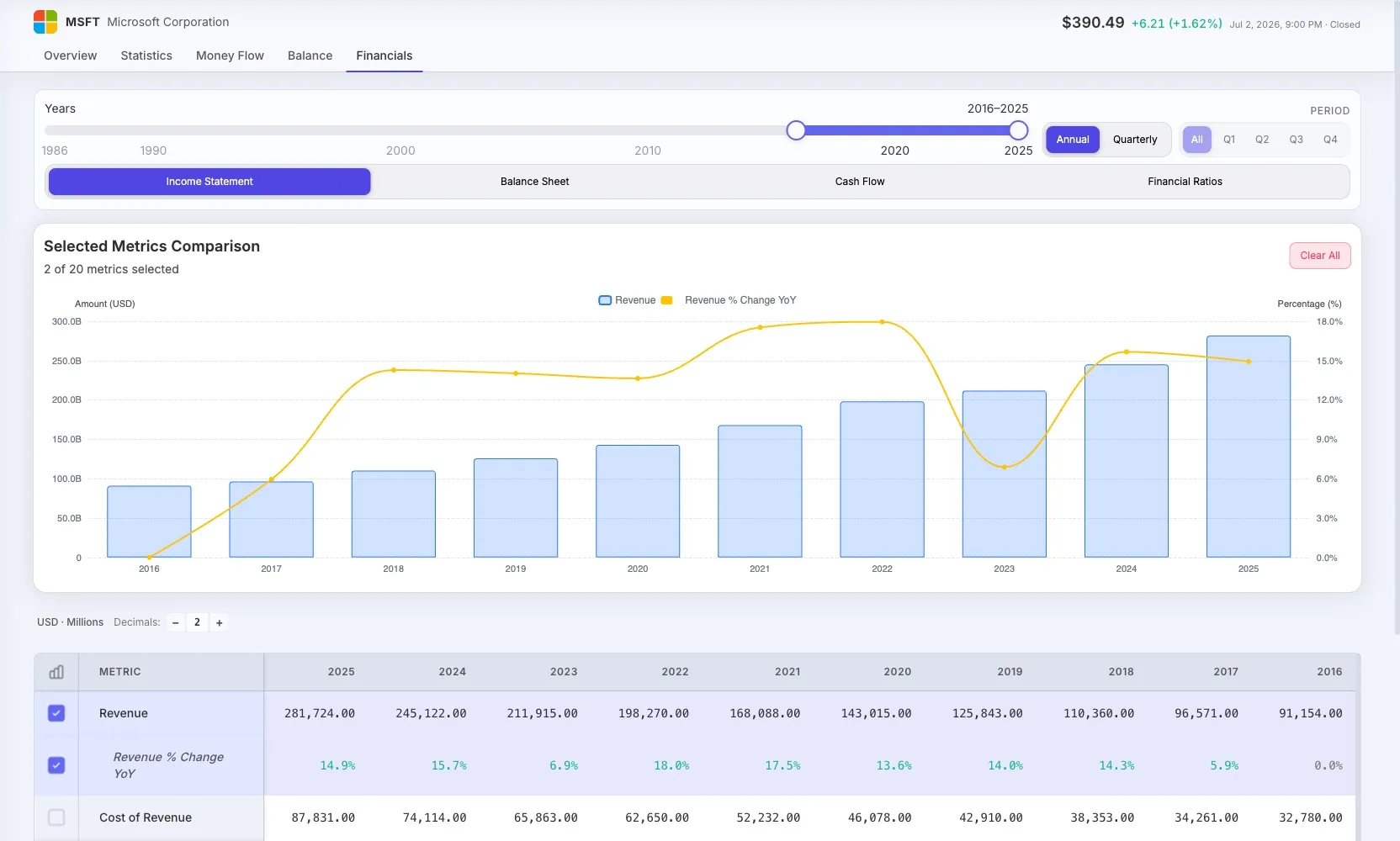
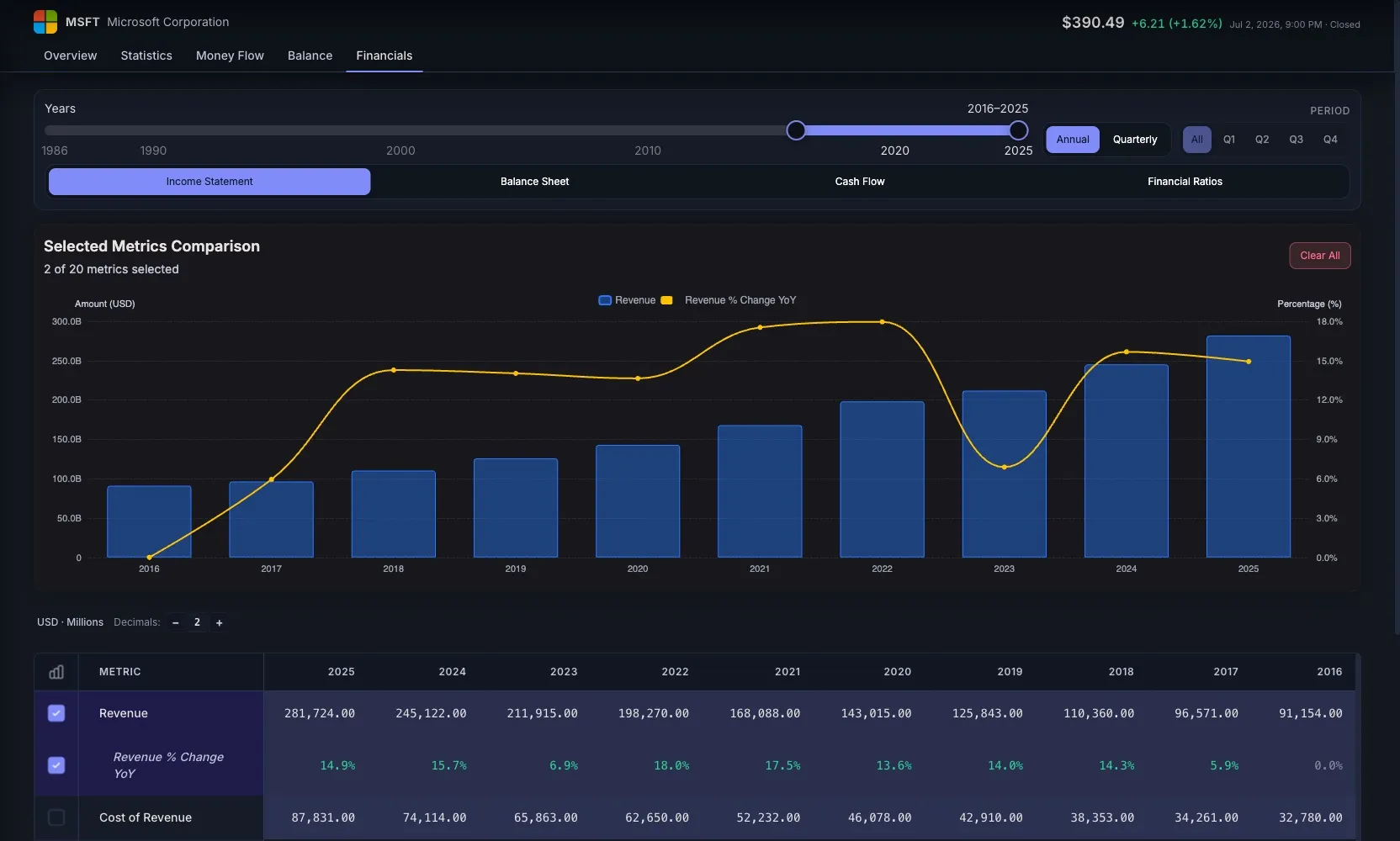
Notice the bottleneck: step 1. The quality of the whole analysis depends on having reliable, structured data ready to paste. And that’s the real manual work for most retail investors: gathering multi-year fundamentals, for several companies, from several websites.
Where STOK Terminal fits
Right at that bottleneck. STOK Terminal is a stock-research app for independent investors that brings fundamentals, financial statements, ratios, watchlists and portfolio tracking into a single workflow. The idea is simple: to have reliable, structured multi-year data in front of you — the data you need to feed your analysis (with AI or without it) — without juggling five tools.
To be transparent: STOK Terminal is in early access via waitlist. Joining is free and triggers no charge; when you accept your invitation, access is €6.95/month. It’s not a finished product and it doesn’t replace your judgment. It’s an informational tool, not financial advice.
Frequently asked questions
Can ChatGPT reliably analyze a stock? It can help you summarize filings, explain concepts and structure a thesis, but it is not reliable at recalling figures — it invents prices, ratios and dates. Give it verified data yourself and ask it to reason over that data.
Is Gemini or ChatGPT better for investing? Gemini tends to be better when you need recent data thanks to its search access; ChatGPT excels at writing and reasoning. For serious fundamental analysis, what matters most is not which one you pick but that you feed it reliable data instead of asking it to recall numbers from memory.
Does AI replace fundamental analysis? No. It speeds up tasks like summarizing, explaining and structuring, but gathering reliable data, verifying it and making the final decision are still yours.
Why does AI make up financial data? Because a language model predicts plausible text; if it doesn’t have the real figure available, it generates one that sounds right. That’s why you must give it the numbers and verify them.
This article is informational and does not constitute financial advice or investment recommendations. Always verify data against official sources before making decisions.
Stop gathering data by hand to analyze one company
STOK Terminal brings fundamentals, watchlists and portfolio tracking into one workflow, built for investors who research companies themselves.
👉 Join STOK Terminal free — to have reliable data in front of you, whether you use AI or your own judgment.